Parts Shop
 Store Locator
 131 723
What is an intercooler and what does it do?
Back to Info & Advice//
If your vehicle has a turbocharger or supercharger, an intercooler plays an important role in helping the engine perform at its best. While many drivers are familiar with radiators and cooling systems, intercoolers work behind the scenes to improve power, efficiency, and engine reliability.
When air is compressed by a turbocharger or supercharger, its temperature rises significantly. Hot air is less dense, meaning it contains less oxygen for combustion. An intercooler solves this problem by cooling the compressed air before it enters the engine.
Acting as a heat exchanger, the intercooler lowers the temperature of the pressurised air travelling to the intake manifold. Cooler, denser air contains more oxygen, allowing the engine to burn fuel more efficiently. The result is improved performance, better fuel economy, and more consistent power delivery, particularly in turbocharged and diesel vehicles.
Intercooler explained: from hot compressed air to cooler, denser air
A turbocharger increases engine performance by forcing more air into the combustion chamber. During this compression process, the air temperature rises significantly. Hot compressed air is less dense, meaning it contains less oxygen for combustion.
An intercooler cools this compressed air before it enters the engine. By reducing air temperatures, the intercooler increases air density, allowing more oxygen into the combustion process. This helps the engine burn fuel more efficiently and produce more consistent power.
The cooling process works similarly to a radiator. As pressurised intake air passes through the intercooler’s internal tubes and fins, heat is transferred away from the air and released into the surrounding ambient air or coolant, depending on the intercooler design.
Why turbocharged and diesel engines need an intercooler
Turbocharged and diesel engines generate higher intake air temperatures because they rely on compressed air to increase engine performance and efficiency.
Without an intercooler, the hot air produced by the turbocharger becomes less dense and contains less oxygen. This reduces combustion efficiency and can limit power output. Excess heat may also increase the risk of engine knock in petrol engines or place additional thermal stress on diesel engines operating under load.
An intercooler improves the combustion process by cooling the intake air before it reaches the combustion chamber. Cooler air supports:
- More efficient combustion
- Better power delivery
- Improved fuel efficiency
- Lower exhaust gas temperatures
- More reliable performance during towing or heavy-duty driving
Diesel vehicles, 4WDs, trucks, and performance cars often rely heavily on intercoolers because these vehicles regularly operate under high thermal loads.
Do all turbo engines have intercoolers?
Not all turbocharged engines use an intercooler, although most modern turbo engines do.
Whether an intercooler is required depends on the engine design, intended performance, and boost pressure levels. Engines running lower boost pressure may not generate enough heat to require additional cooling. In contrast, higher-performance turbocharged engines typically rely on intercoolers to maintain efficiency and protect engine components.
Some older turbo vehicles or smaller turbocharged engines may operate without an intercooler, but this is less common in modern automotive design.
Intercooler vs radiator: what’s the difference?
Although intercoolers and radiators are both heat exchangers, they perform different roles within a vehicle’s cooling system.
An intercooler cools compressed intake air from the turbocharger or supercharger before it enters the engine. Its purpose is to reduce air temperatures, increase air density, and improve combustion efficiency and engine performance.
A radiator, on the other hand, cools the engine coolant circulating through the engine. The radiator removes excess heat generated by combustion to help prevent the engine from overheating.
The main difference comes down to what each component cools:
| Component | What it cools | Main purpose |
|---|---|---|
| Intercooler | Compressed intake air | Improve air density and engine efficiency |
| Radiator | Engine coolant | Regulate engine operating temperature |
Intercoolers are typically found in turbocharged or supercharged vehicles, while radiators are essential in nearly all internal combustion engines.
Both systems work together to support reliable engine operation. A radiator controls overall engine temperature, while an intercooler helps maintain cooler intake air for more efficient combustion and improved performance.
Because both components manage heat, problems with either system can affect fuel efficiency, engine reliability, and overall vehicle performance.

Types of intercoolers
The two main types of intercoolers used in automotive applications are air-to-air and air-to-liquid. Both systems are designed to cool compressed air from turbochargers or superchargers before it enters the engine, but they use different cooling methods.
The best intercooler design depends on factors such as available space, vehicle use, boost pressure levels, and desired engine performance.
Air-to-air intercooler
An air-to-air intercooler uses ambient airflow to cool compressed air coming from the turbocharger compressor.
As hot, pressurised air moves through the intercooler’s internal tubes and fins, outside air passes over the intercooler core, removing heat through convection. This lowers intake air temperature before it reaches the engine.
These intercoolers are often mounted at the front of the vehicle to maximise airflow. Front-mounted intercoolers are especially popular in performance vehicles and 4WD applications because they can handle higher boost pressure and larger turbo systems measured in PSI or kW output.
They can improve engine efficiency, reduce turbo lag in some applications, improve combustion efficiency, lower intake air temperatures, and potentially lower vehicle emissions. However, their performance can depend heavily on airflow. In stop-start traffic or hotter Australian conditions, cooling efficiency may reduce if ambient airflow is limited.
Air-to-liquid (liquid-to-air) intercooler
An air-to-liquid intercooler uses a coolant circuit to remove heat from compressed air.
Instead of relying on outside airflow, the intercooler transfers heat from the intake air to the liquid coolant. The heated coolant then travels through a separate heat exchanger, where it releases heat before recirculating through the system. Since coolant absorbs heat efficiently, these systems can provide more stable cooling performance in situations where airflow is limited.
Some modern vehicles also use sensors to monitor intake air temperatures and intercooler performance, helping optimise combustion efficiency and boost control.
Intercooler mounting locations and why they matter
Front-mounted intercooler
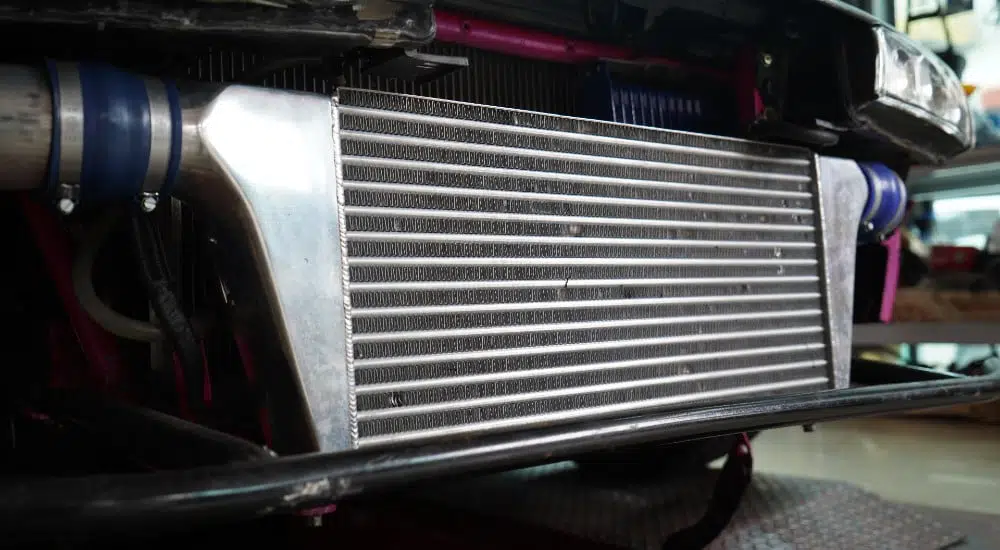
A front-mounted intercooler sits behind the front bumper and grille, where it receives strong, direct airflow. This position makes it one of the most effective intercooler setups for reducing intake air temperatures.
Front-mounted intercoolers are commonly used in performance vehicles, diesel 4WDs, and modified turbocharged engines running higher boost pressure or increased kW output. Their larger cores help manage heat more effectively during towing, heavy acceleration, or driving in warmer Australian conditions.
The main advantage is consistent cooling efficiency under load. However, the longer pipework required for installation can slightly affect turbo response if the system is not properly designed.
Top-mounted intercooler
A top-mounted intercooler sits above the engine and relies on a bonnet scoop or ducted airflow to cool compressed air.
This setup is common in factory turbocharged vehicles where front-end space is limited. Because the intercooler sits closer to the turbocharger and intake system, the shorter pipework can help improve throttle response and reduce turbo lag.
Top-mounted intercoolers are popular in some performance and off-road vehicles because of their compact design. However, cooling efficiency can drop in slow-moving traffic or hot conditions, where engine bay heat may affect airflow and intake air temperatures.
Side-mounted intercooler
A side-mounted intercooler is usually positioned in one corner of the front bumper area and is commonly used in compact factory engine layouts.
This design allows manufacturers to package turbocharged systems efficiently without requiring a large front-mounted intercooler. Side-mounted intercoolers are typically found in smaller turbo vehicles designed for standard boost pressure and everyday driving.
While they can provide reliable cooling performance in factory applications, their smaller size and reduced airflow exposure may limit efficiency in high-performance setups or vehicles running upgraded turbos.
Choosing the best intercooler for your vehicle
The best intercooler for your vehicle depends on three main factors: vehicle use, boost pressure, and available mounting space.
For standard daily driving, a factory intercooler is often enough. However, vehicles used for towing, off-road driving, or performance upgrades may benefit from a larger or more efficient intercooler setup.
Higher boost pressure generates more heat, so upgraded turbocharged engines typically require improved cooling capacity to maintain performance and combustion efficiency.
Mounting space also matters. Some vehicles can accommodate larger front-mounted intercoolers, while others may suit more compact top-mounted or side-mounted designs.
The right intercooler should improve cooling efficiency without compromising airflow, reliability, or installation practicality.
Common intercooler faults and symptoms
Intercooler problems can reduce cooling efficiency, affect boost pressure, and impact overall engine performance.
One of the most common faults is a boost leak caused by cracked pipes, damaged hoses, or a leaking intercooler core. When compressed air escapes, the engine may struggle to maintain consistent performance.
Common signs of intercooler problems include:
- Loss of power or reduced engine performance
- Increased turbo lag
- Poor fuel efficiency
- Hissing noises under acceleration
- Excessive exhaust smoke in diesel vehicles
- Oil around intercooler pipes or connections
Physical damage, blocked fins, or corrosion can also reduce the intercooler’s ability to cool compressed air effectively, especially under load or in hotter driving conditions.
When to upgrade or replace your intercooler
An intercooler may need to be replaced if it becomes damaged, develops boost leaks, or can no longer cool compressed air effectively.
Drivers also commonly upgrade intercoolers when increasing boost pressure or modifying a turbocharged engine. Higher power demands create more heat, and the factory intercooler may not have enough cooling capacity to maintain efficient performance under load.
Upgrading to a larger or more efficient intercooler can help improve intake air temperatures, combustion efficiency, and overall engine reliability, especially in towing, off-road, or high-performance applications.
Talk to Natrad about intercooler repairs or upgrades
If your vehicle needs intercooler repairs, replacement, or improved cooling performance, Natrad can help.
Natrad specialises in intercooler services for turbocharged and diesel vehicles, including diagnostics, repairs, and upgrade solutions for passenger cars, 4WDs, trucks, and performance vehicles. With over 40 service centres across Australia, Natrad delivers trusted cooling system expertise backed by decades of specialist experience.
Book an intercooler inspection at your nearest Natrad service centre today.